
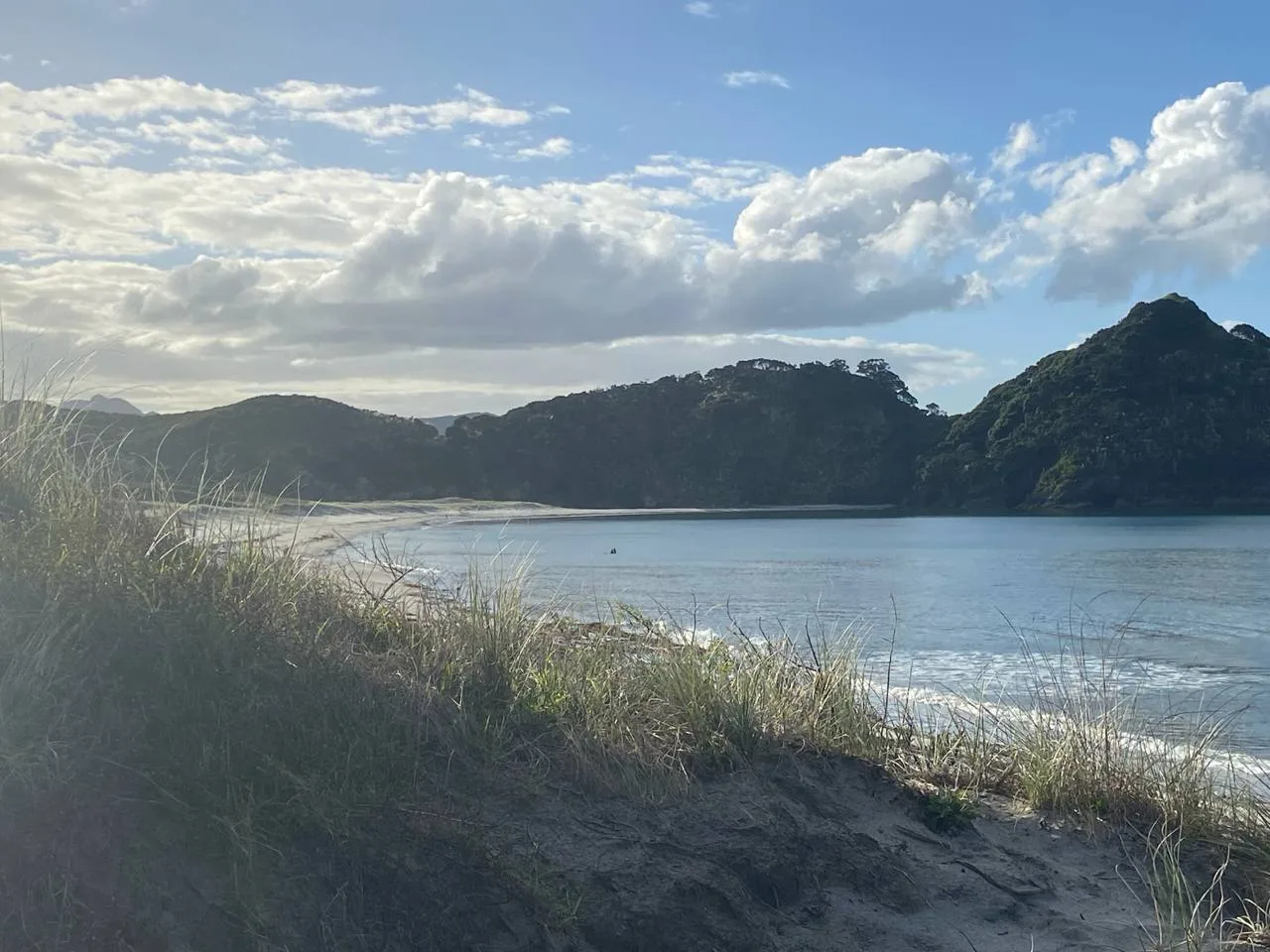
Everyone goes to Great Barrier Island in January. The people who’ve actually figured it out go in May.
January is the month you fight for a ferry ticket, pay peak rates, and share Medlands Beach with half of Auckland’s eastern suburbs. May is when the island goes quiet, the water stays warm, and you can hear yourself think for the first time in months. Great Barrier Island autumn is not a consolation prize. It’s the main event.
The Water Is Still Warm (Seriously)
The Hauraki Gulf holds its heat well into autumn. By May, you’re looking at sea temperatures hovering around 18–19°C — comfortably swimmable, and good enough for a proper surf session at Medlands.
Medlands Beach is an eight-minute walk from our houses. It’s a long, powerful surf beach — one of the best in New Zealand. In January, it’s shared. In May, it’s not. You’ll have stretches of it entirely to yourself, with conditions that are often cleaner than the chaotic summer swell.
The ocean doesn’t care that summer is technically over. You shouldn’t either.
The Beach Is Actually Yours
Here’s the January reality: popular beaches in the Hauraki Gulf fill up fast. Even on an island with 1,200 permanent residents, summer sees enough visitors to make solitude feel elusive.
Great Barrier Island in May is a different place. The day-trippers are gone. The bach owners have locked up and left. The beach you drove past forty times on Google Maps — the one that made you book a flight in the first place — is genuinely empty.
There’s a particular kind of silence at Medlands on a May morning. The water, the sand, the pōhutukawa trees going golden. You’ll come back to Auckland remembering what silence actually sounds like.
That’s not marketing. That’s just what happens when the crowd leaves and the island gets to be itself again.
The Nights Get Serious
Aotea Great Barrier Island is New Zealand’s only Dark Sky Sanctuary in the Hauraki Gulf. No street lights. No light pollution. No mains electricity anywhere on the island.
In summer, the nights are short. You get a few hours of dark sky before it starts getting light again. In May, the nights stretch out. By mid-autumn you’re getting proper, long, ink-black nights — and with the air clearing after summer haze, the stargazing on Great Barrier Island reaches another level entirely.
The Milky Way. The Magellanic Clouds. Satellites tracking slowly overhead. All from the deck of your house, wood burner going inside, no effort required.
This is when the winter Great Barrier Island experience starts to earn its reputation. The dark sky season doesn’t begin in June — it begins now.
Kaitoke Hot Springs in the Cool
Kaitoke Hot Springs is a 40-minute bush walk from the carpark, completely free, and naturally warm. In January, you queue. In May, you don’t.
Here’s the thing about hot springs: they’re better when it’s cool. Soaking in warm water on a hot summer day is fine. Soaking in warm water while the autumn air bites and the bush is quiet around you — that’s the version worth travelling for.
The walk itself is worth it. Autumn colours in the native bush, fewer people on the track, and a destination that actually earns the journey. Bring a towel. Wear shoes you don’t mind getting muddy.
What It Costs vs What You Get
Let’s be direct about this.
Tree House sleeps 8 people. In May, it’s $300/night shoulder season, dropping to $225/night from 1 May.
The base rate covers up to 4 guests. Add more people at $50/person/night — so a group of 8 works out to $425/night, or $53 per person. That’s a night in one of New Zealand’s most remote, off-grid properties, two minutes from Medlands Beach. Less than a mid-range Auckland restaurant.
For that you get: solar power, Starlink WiFi, a wood burner, full kitchen, hot showers, Nespresso, and a beach that’s genuinely empty in May.
Ruru House sleeps 7 at $275/night base ($50/person above 4). Pītokuku House sleeps 10 at $325/night base ($50/person above 4).
The flights are cheaper too. Barrier Air runs the Auckland–Great Barrier route, and May fares are noticeably lower than peak January prices. SeaLink ferry is always an option if you want to bring the car.
Peak season pricing exists because people pay it. Off-season Great Barrier Island pricing exists because the island wants you to show up — and the experience in May is worth every cent of whatever you’d pay in January anyway.
If you want to lock in dates before the good ones go, check availability here. May books out slower than January, but it does book out.
The Rest of It
Aotea Brewing is a five-minute walk. So is Aotea Roast — good coffee, no pretension. The Currach Irish Pub down in Tryphena does what a good island pub should do.
The island runs entirely on solar, rainwater, and the kind of resourcefulness that comes from being genuinely remote. No traffic lights. No mains grid. Around 1,200 people who chose to be there.
Waiheke is lovely. Great Barrier Island is the real thing.
Come in May
You now know something most Auckland people don’t: Great Barrier Island autumn is better than summer by most measures that actually matter. Warm enough to swim. Quiet enough to breathe. Dark enough to see the stars. Cheap enough to actually do it.
January will still be there next year, with all its crowds and peak pricing and ferry queues. May is happening right now.
Stay Here While You Do This
Three off-grid houses at Medlands Beach. All solar powered. All with wood burners, Starlink, full kitchens, Nespresso, and an eight-minute walk to the beach.
- Pītokuku House — sleeps 10 — from $325/night
- Ruru House — sleeps 7 — from $275/night
- Tree House — sleeps 8 — from $225/night