
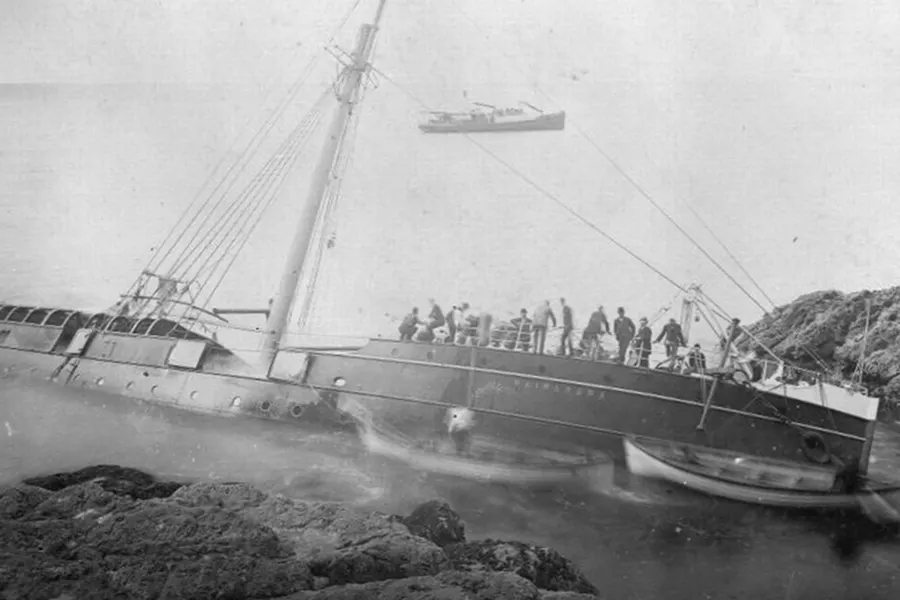
Twenty-eight years and almost the full length of Great Barrier Island separated two of New Zealand’s best-known shipwrecks.
The Wairarapa struck Miners Head in 1894. More than 120 people died. The Wiltshire hit the rocks near Rosalie Bay in 1922, broke in two, and somehow every one of its 103 crew survived.
Both ships were close to Auckland. Both were travelling through darkness and bad weather. What happened after impact could hardly have been more different.
The Wairarapa: Full Speed into Miners Head
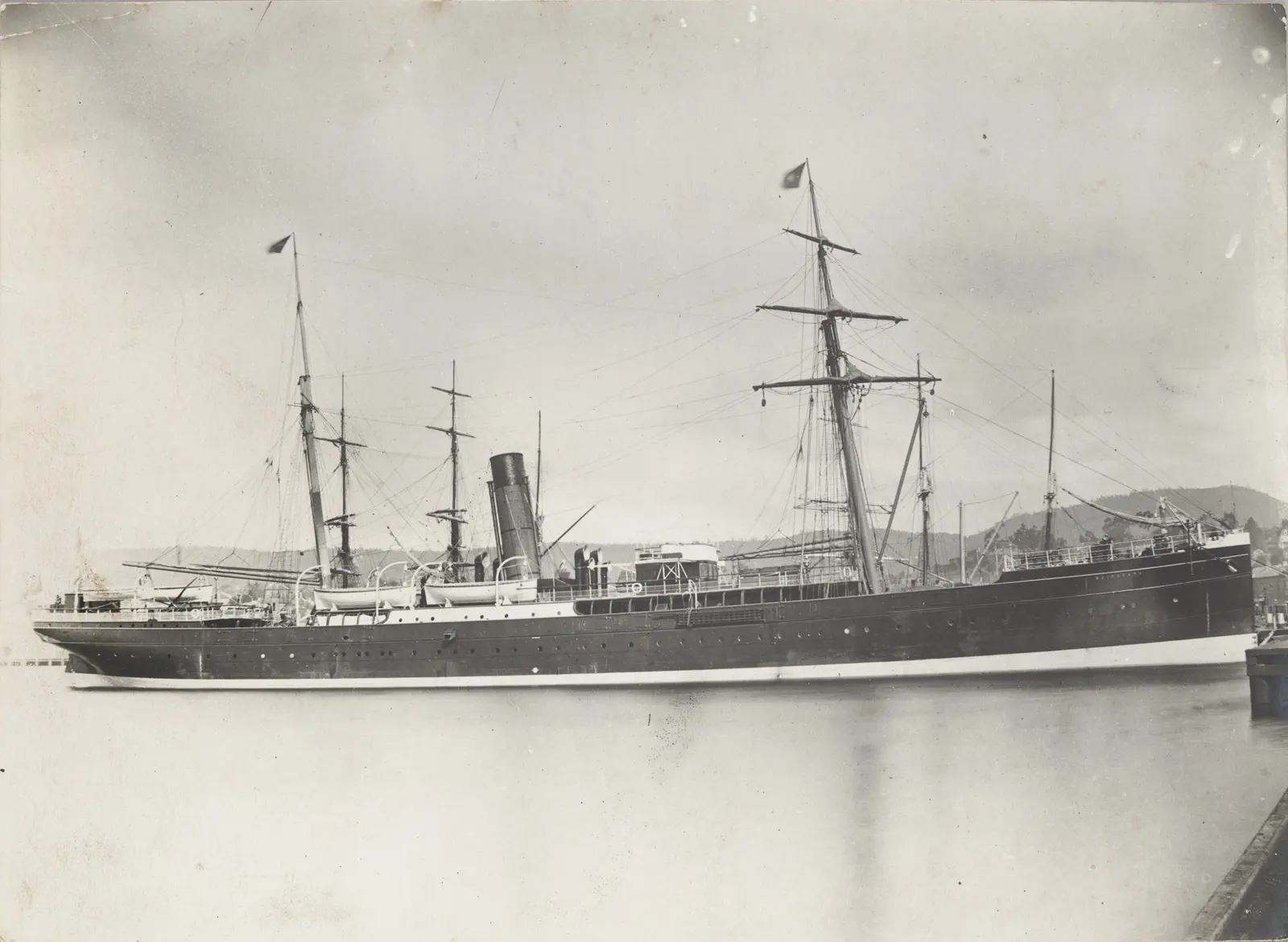
The Union Steam Ship Company’s Wairarapa was one of the fastest passenger steamers working between Australia and New Zealand. It left Sydney for Auckland carrying passengers, crew, mail and cargo.
Fog thickened as the ship approached northern New Zealand on 28 October 1894. Captain John McIntosh continued at about 13 knots, close to full speed. The ship had taken the wrong course from the Three Kings Islands and had not allowed sufficiently for currents. Those errors carried it towards Aotea rather than safely into the Hauraki Gulf.
At eight minutes past midnight on 29 October, the Wairarapa drove into the cliffs near Miners Head.
The impact opened the hull and left the steamer listing against a steep, hostile coast. Heavy seas swept people and wreckage from the decks. Some boats were smashed or swamped as they were launched; two managed to rescue about 50 people from the water.
Those left aboard climbed into the rigging and onto the bridge. At daylight, steward Thomas Roberts swam through the surf with a line. Survivors then hauled themselves between the ship and rocks, reaching land battered, wet and with little shelter.
Thirty Hours on the Rocks
The survivors remained stranded for more than 30 hours. Aotea had no telegraph connection and only intermittent shipping, so Auckland knew nothing of the disaster for three days.
Ngāti Rehua people from Katherine Bay reached the survivors, brought them to safety and provided food, clothing and care. They also recovered bodies along the coast and helped with the burials. Their role is central to the story, not a footnote added after the ship and its captain.
The exact death toll has never been settled completely. NZ History records 121 lives lost; later research places the number closer to 130 because the passenger list was uncertain. Either figure makes it New Zealand’s third-deadliest shipwreck.
The Court of Inquiry placed primary responsibility on Captain McIntosh, who died in the wreck. It found that he maintained excessive speed, chose the wrong departure course and failed to allow for currents.
The disaster exposed just how isolated Great Barrier Island was. That communication problem eventually helped produce the island’s wonderfully improbable solution: the Great Barrier Island pigeon post, regarded as the world’s first regular commercial airmail service.
The Wiltshire: A Ship Breaks in Two
On 31 May 1922, the Federal Steam Navigation Company’s Wiltshire was nearing Auckland after sailing from Liverpool through the Panama Canal. It carried 103 crew, no passengers and roughly 10,000 tons of general cargo.
The weather was atrocious. Cuvier Island’s light was not seen, and a sounding suggested the water was shallower than expected. Captain Basil Hayward nevertheless continued at speed. Shortly before midnight the Wiltshire struck the rocks below Rosalie Bay, near Cape Barrier at Aotea’s southern end.
Radio changed everything. The ship transmitted distress messages, and nearby vessels knew within hours that it was in grave danger. The Katoa, Arahura, tug Te Awhina and naval personnel responded, but the seas were too violent for a boat to approach safely.
By the following day the ship had broken in two. Its stern disappeared into deeper water while the crew crowded onto the forward section, which remained jammed against the rocks.
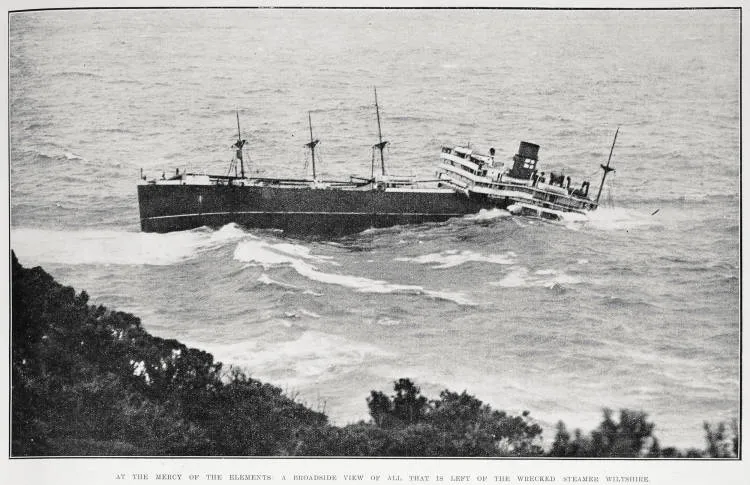
The Rescue across Rosalie Bay
A party from the Katoa landed at Tryphena and crossed about eight kilometres of rough country with local guides. Great Barrier residents arrived from around the island with horses, food, shelter and whatever else could be carried through the storm.
The only workable rescue route was through the air. A line floated from the wreck had to be caught from the rocks. Seaman J. Kehoe of the Katoa went into the surf and secured it, an act the Wiltshire crew later said made their rescue possible.
The line was fixed to a tree above the shore and developed into a pulley system between the wreck and cliff. One by one, the crew were hauled over the water. The operation took two days. All 103 survived.
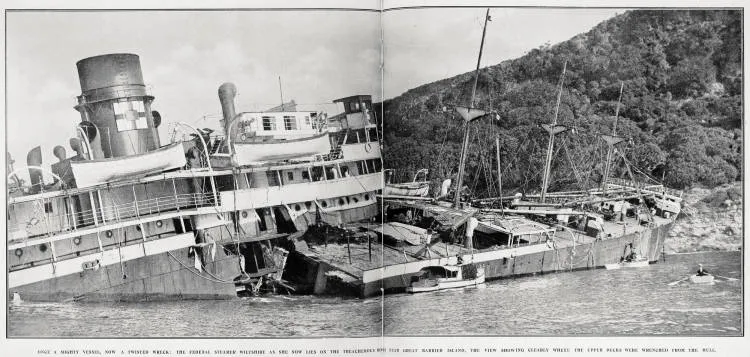
The Marine Court later found that Captain Hayward had made an error of judgment by continuing at speed after the Cuvier light failed to appear and by not responding sufficiently to the warning contained in the sounding. His certificate was returned, although he was ordered to pay the inquiry costs.
Then came the salvage. Mail bags, furniture, timber, whisky, cigarettes and other cargo washed along the coast. Divers worked the wreck for more than a year, while island families reused material that came ashore. Shipwreck archaeology with a practical local afterlife.
What Remains on Great Barrier Island
The Wairarapa wreckage lies scattered across about 400 metres of seabed beneath Miners Head, generally at depths of 4–15 metres. The site is historically protected and exposed to rapidly changing sea conditions.
On land, grave sites at Onepoto in Katherine Bay and Tapuwai Point at the northern end of Whangapoua beach hold unidentified victims. DOC maintains short Wairarapa Graves walking routes. These are cemeteries, not quirky roadside attractions. Visit quietly and leave everything as you find it.
The Wiltshire remains off Rosalie Bay and is also known as a dive site, but it sits on a remote, weather-exposed stretch of coast. Neither wreck is something to attempt without local knowledge, the right conditions and a suitably experienced operator.
For accessible island history, the Milk, Honey & Grain Museum in Claris is the easier starting point. Our complete Great Barrier Island guide covers the museum, northern grave walk and other historic places worth visiting.
The wrecks are more than two navigational failures. They show Aotea at two different moments: isolated enough in 1894 that news took three days to reach Auckland, but connected by radio in 1922 quickly enough to mobilise ships, sailors and island residents through a full easterly gale.
Stay at 175° East in Medlands Beach while you explore Aotea’s history, beaches and tracks. All three houses are an eight-minute walk from the sand. Check availability →
Frequently Asked Questions
How many people died in the SS Wairarapa wreck?
NZ History records 121 deaths. Later estimates put the number at approximately 130 because the passenger list was uncertain.
Did anyone die in the SS Wiltshire wreck?
No. All 103 crew members were rescued using a line and pulley system rigged between the broken ship and the cliffs at Rosalie Bay.
Can you visit the Wairarapa graves?
Yes. DOC describes short walking routes to the Onepoto grave site in Katherine Bay and the Tapuwai Point graves at the northern end of Whangapoua beach.
Can you dive the Wairarapa and Wiltshire wrecks?
Both are known dive sites, but they lie on exposed parts of Aotea’s coast. Conditions, access and legal protection need to be checked with an experienced local operator.
Sources: NZ History — SS Wairarapa, DOC — Wairarapa Graves tracks, DOC heritage assessment, Te Ara — Wiltshire rescue, Papers Past — contemporary Wiltshire report and Marine Court finding.
Image credits: SS Wairarapa at wharf by Allan C. Green, State Library Victoria, public domain; Wairarapa wreck photograph, Alexander Turnbull Library, public domain; Wiltshire wreck photographs, Auckland Weekly News via Auckland Libraries Heritage Collections, no known copyright restrictions.