
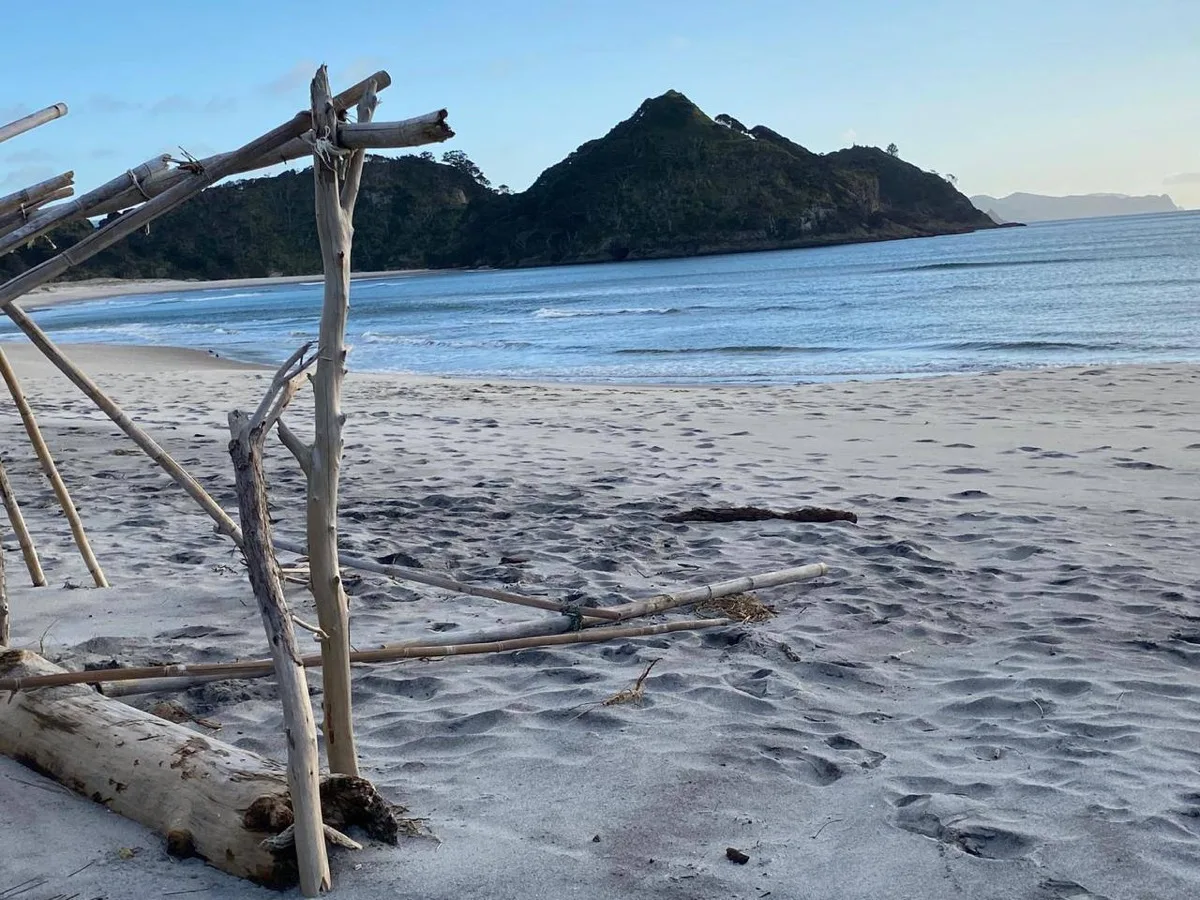
Great Barrier Island doesn’t do romantic in the conventional sense. There’s no champagne turndown service. No rooftop bar. No spa with a menu of treatments.
What it has is better.
A clawfoot bath that opens to the treetops. A fire crackling while the bush goes dark outside. Geothermal pools reached on a 40-minute walk through forest where you’re unlikely to pass another soul. A beach so empty at sunset you can hear the surf from 200 metres away. And skies — genuine, uninterrupted dark skies — that make you question whether you’ve ever actually seen the Milky Way before.
Aotea Great Barrier Island is 90km from Auckland and operating on a different set of rules entirely. No power grid, no traffic lights, around 1,200 permanent residents. No obligations, no schedules, no one who knows where you are.
Just the two of you, an off-grid house, and as much time as you’re willing to take.
This is what a couple’s trip here looks like.
Where to stay
All three houses have fireplaces. This matters more than you’d think — there’s something about a fire that strips a trip down to its essentials. You stop looking at your phone. You share a drink and some yummy food …
The Tree House — for the bath
The Tree House is suspended among mānuka and kānuka on the upper edge of the 175° East estate. An elevated deck built into the canopy. Hammocks strung between trees. A fireplace for the evenings. And a deep red clawfoot bath that opens directly to the treetops — that’s become its signature.
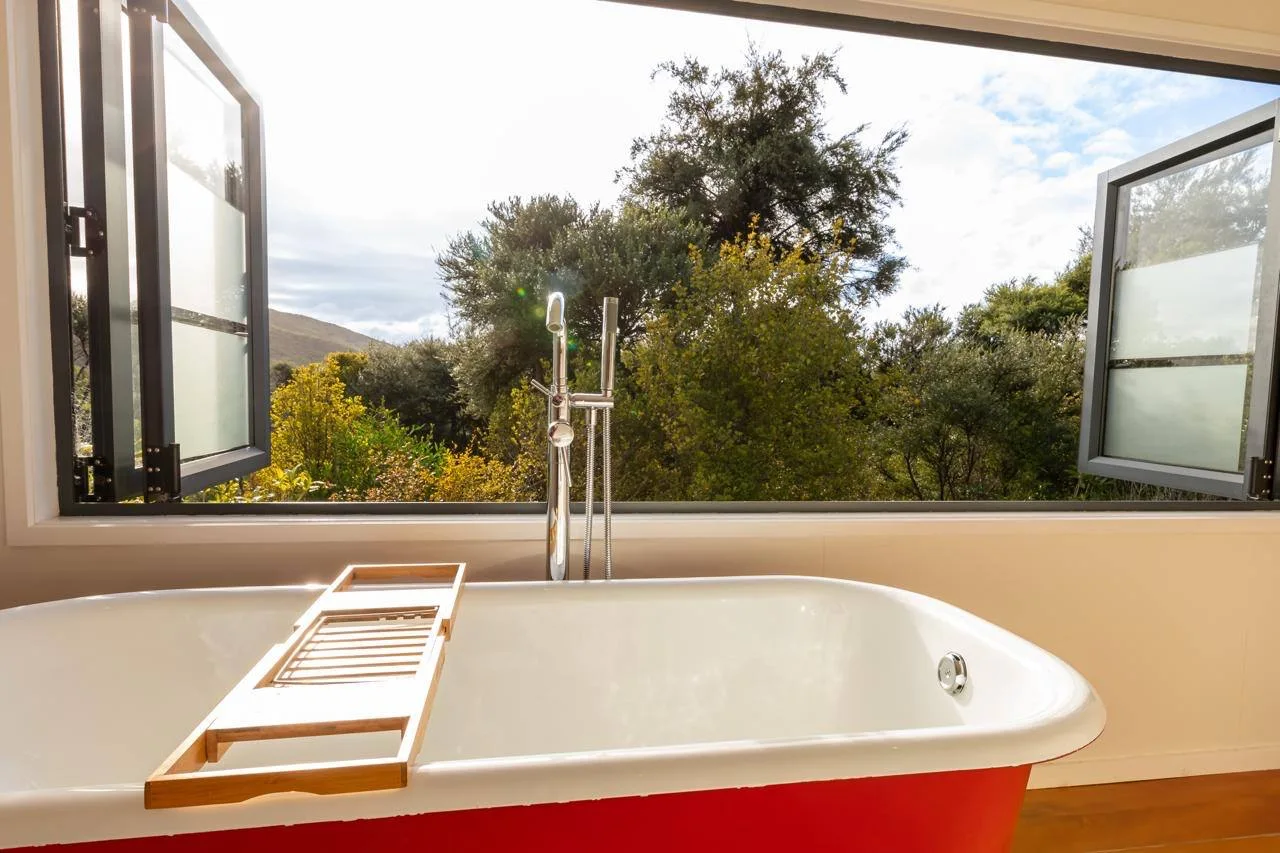 The Tree House clawfoot bath — windows open to the native bush canopy.
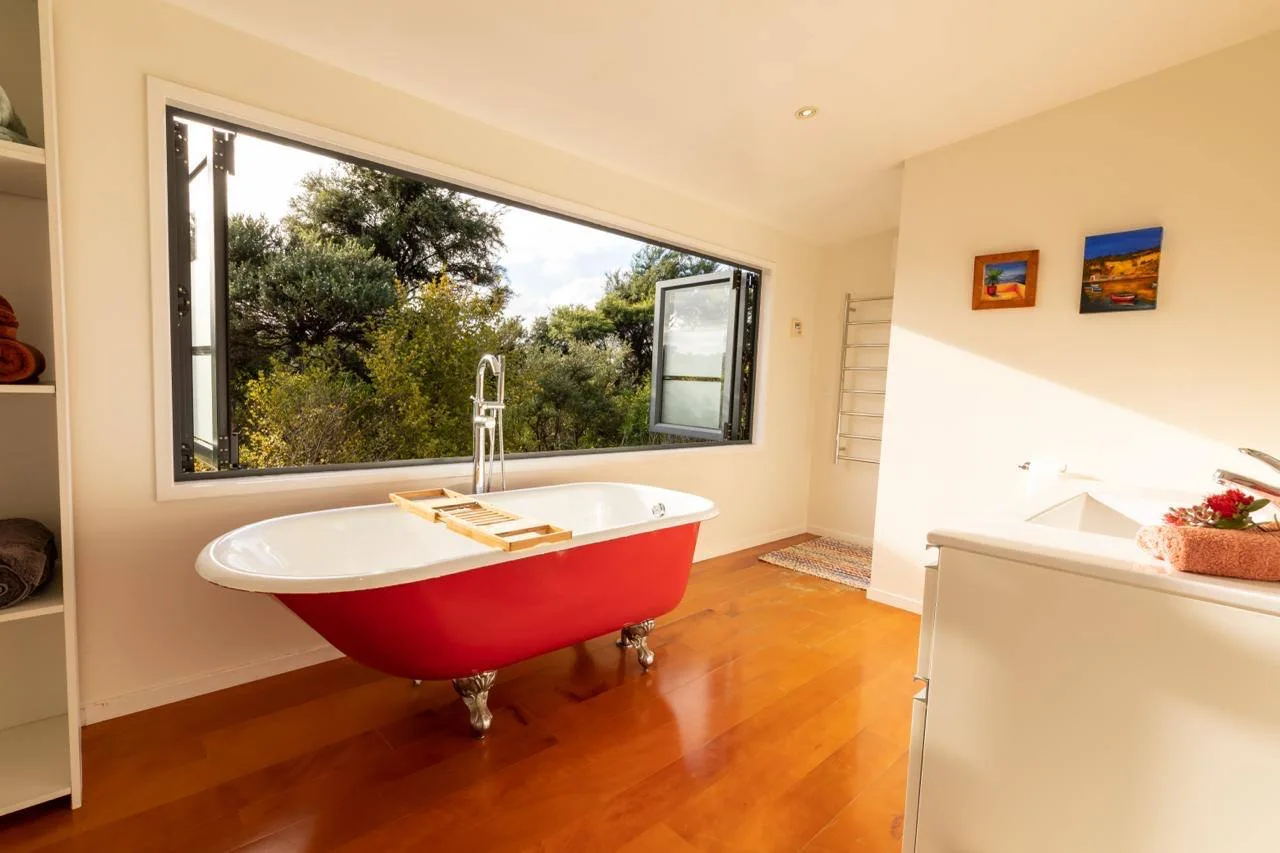 The full bathroom — kauri floors, red clawfoot bath, bush views.
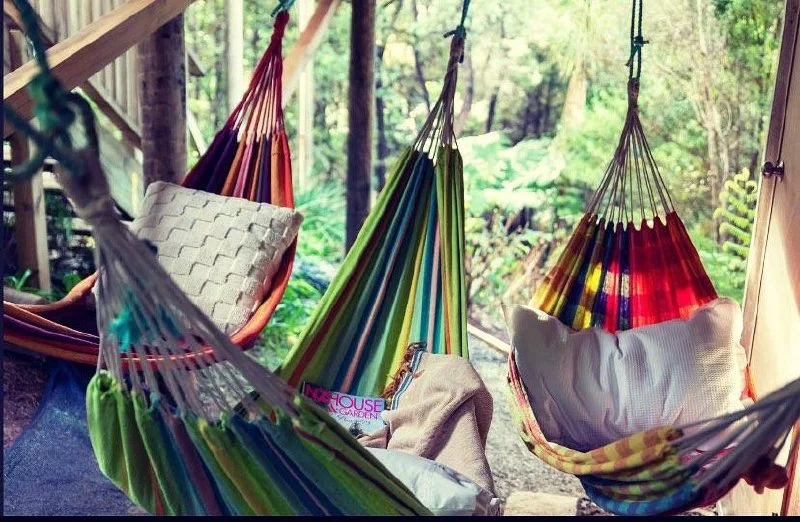 The Tree House deck — hammocks in the canopy, native bush all around.
There’s a peek-through-trees view of Medlands Beach from the deck. Run the bath, light the fire, pour something good. In the evening, with the birds calling in the bush below and nothing else on the agenda, it’s about as far from ordinary life as you can get in a 30-minute flight.
Sleeps up to 8, but best as a couple’s retreat when it’s just the two of you. View the Tree House →
Ruru House — for the privacy
Ruru sits tucked into the hillside with elevated views and a sense of complete seclusion. A wood burner that earns its keep on winter nights. An outdoor shower. North-facing decks that catch the sun from early morning. Three bedrooms — more than enough space to disappear into, intimate enough that it feels entirely yours.
Named for the morepork owl — you’ll hear them calling after dark. No neighbours. No noise except the bush. The kind of quiet that makes you realise how loud your normal life is.
Pītokuku — for the view (and the fires)
Pītokuku is the largest of the three — built for groups, but extraordinary as a couple’s base when you want serious space and zero compromise. All-day sun from the north-facing deck. A panoramic view across native bush to the ocean. An outdoor shower.
And two fireplaces — one inside, one on the back deck. The back deck fire at night, with the view and a glass of something, is the kind of thing that ends up being the memory of the trip.
What to do
Soak in the Kaitoke Hot Springs
A 40-minute return walk through kānuka and native orchids from the carpark on Kaitoke Road. The geothermal pools are dammed at a fork in Kaitoke Creek — warm springs meeting cold water, ringed with umbrella fern. The temperature varies depending on where you sit. Five minutes further upstream: hotter, more enclosed, and usually quieter.
Go early morning or late afternoon to avoid the school-holiday crowds. In winter, the contrast between cold air and warm water is the actual experience — and you’ll often have the pools entirely to yourselves.
Free. DOC-managed. Full guide to Kaitoke Hot Springs →
Watch the stars
Great Barrier Island is one of only a handful of places in the world designated an International Dark Sky Sanctuary. There’s almost no artificial light on the island at night. On a clear, moonless evening you can see the full arc of the Milky Way, the Magellanic Clouds, and enough shooting stars that you’ll stop counting.
No equipment needed. Just step outside and look up. The best conditions are away from Claris (the only meaningful light source on the island) and on moonless nights — check the lunar calendar before you book if this is a priority.
Winter nights are longer and the skies are often clearer. If stargazing matters, May through August is the prime season.
Walk a beach that’s actually empty
Medlands Beach is 1.5km of white sand — and on most days outside of Christmas week, you’ll share it with almost nobody. In winter, possibly nobody at all.
Sunrise at Medlands is worth setting an alarm for. The light comes from behind the headland to the northeast and hits the water golden for about 20 minutes before the sun clears the ridge. The beach is an 8-minute walk from the 175° East houses.
Taste the local gin
Island Gin makes an internationally awarded gin from Great Barrier Mānuka and bush honey — solar distilled, rainwater filtered, bottled in a kina-inspired vessel made from recycled New Zealand glass. Tastings are available at its Aotea distillery; check current opening details before visiting. Bottles are also available at The Rocks bottle shop in Claris.
Pair it with a sundowner on the deck. It tastes better here than anywhere else.
Eat wood-fired pizza in a garden
Fat Puku at Claris is a lovely spot for a sit-down meal — wood-fired pizza from a Pompeii oven, seasonal produce, and their own Puku Brew beer and kombucha. Set in a garden that feels entirely right for a remote island in the Hauraki Gulf.
Open Monday–Friday 8am–2pm, Saturday–Sunday 9am–2pm.
Have a pint at The Currach
The Currach Irish Pub in Tryphena is the island’s social hub — cold Guinness, food, live music on weekends, quiz nights on Sundays. The kind of pub where you end up talking to a local until closing time without meaning to. Open seasonally — check currachirishpub.co.nz for current hours.
Best time to go
Summer (December–March): Warm, long days, beach swimming at its best. Busier, and the best accommodation books out months in advance. Book early.
Shoulder (April–May, September–November): The sweet spot for couples. Warm enough, quieter beaches, better rates. Autumn on GBI has a particular quality — golden light, fewer people, and the island starting to settle back into itself.
Winter (June–August): The best stargazing. The hot springs practically to yourselves. The beaches empty. Ruru House with the wood burner on is hard to beat in June. Rates are at their lowest. Not for everyone — but for couples who want the island at its most itself, winter is extraordinary.
Practical notes
Getting there: Barrier Air flies from Auckland in 30 minutes — the most romantic way to arrive, frankly. SeaLink runs the ferry in 4.5 hours if you’d rather bring a car and take it slower. Full guide →
How long to go: Three nights is the minimum to properly decompress. Four or five nights is ideal — the island takes a day to get into your system and you don’t want to leave just as it does.
Mobile coverage: Patchy. Download offline maps before you leave Auckland. The Starlink WiFi at 175° East keeps you connected when you need it — but the lack of 4G elsewhere is part of the point.
Book direct: 175° East offers better rates than Airbnb or Booking.com. Get in touch directly and we’ll help plan your stay — transport contacts, what’s open, which beach to hit first.
More on Great Barrier Island: Dark Sky Sanctuary · Kaitoke Hot Springs · Getting Here · Things to Do