
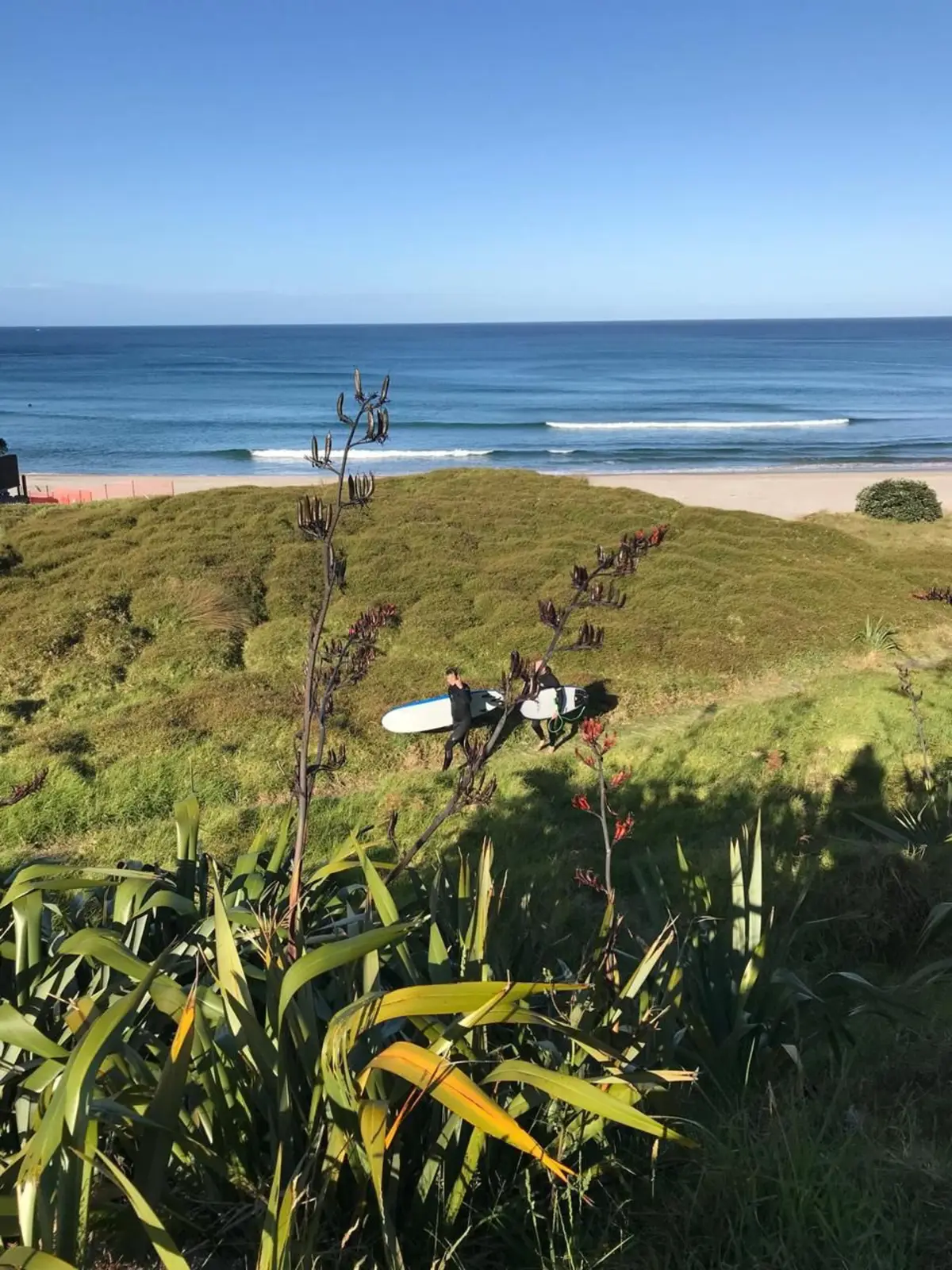
Great Barrier Island doesn’t feature in the surf press. It doesn’t host competitions. It has no surf schools, no board hire shops, and until recently, no reliable way to check the forecast beyond looking at the horizon. None of this is a problem.
The island’s east coast faces northeast into the Pacific, directly in the path of the groundswell that wraps up from Tasman lows and Southern Ocean systems. Three long sandy beaches — Medlands, Kaitoke, and Awana — sit along this coast and share a wide swell window. Whangapoua in the north faces a different direction and works on a different schedule. Between them, something is usually running when there’s swell in the water.
What makes it worth the effort is the crowd count. On a solid day at Medlands — the island’s most consistent break — you might share the water with six people. On a winter weekday, possibly nobody. You can surf a two-hour session, walk back to your accommodation, and drive fifteen minutes to the Kaitoke Hot Springs by lunch. That combination is not available anywhere else in the Hauraki Gulf.
The Breaks
Medlands Beach
The island’s most consistent break and the best starting point. Medlands is an 1,800-metre sandy beach facing northeast — that orientation puts it in a wide swell window. NE, E, and SE groundswell all reach it. When a SE swell wraps into the southern end of the bay, it can produce a defined right-hander that runs for a reasonable distance. Left and rights break across the rest of the bay depending on the sandbars.
surf-forecast.com rates Medlands 4.2/5 for quality on a good day and 4.2/5 for consistency — the highest scores of any break on the island.
- Swell: NE/E/SE groundswell
- Offshore: W/SW (prevailing winter winds are SW — this is favourable)
- Tide: Works most of the tide. Mid-tide generally cleanest.
- Best size: Waist to head-high. Closes out in large, unstructured swell.
- Crowd: Very light. Local attitude rated 4.6/5 — friendly, or absent.
- Skill level: Intermediate as a baseline. The beach is long — beginners can find quieter sections away from the main peaks.
- Access: Via Sandhills Road or Mason Road, short walk through dunes.
- Best season: Winter. February is historically the top month for clean conditions.
Memory Rock sits mid-bay — a volcanic formation visible from the water. It’s the landmark that tells you where you are in the bay. 175° East — three houses sleeping up to 25 guests — is an 8-minute walk from the sand.
Kaitoke Beach
Longer than Medlands and running to the same northeast orientation, Kaitoke is the home break of the Aotea Board Riders Club, the island’s surf community. Left and right breaks, consistent year-round. Rock pools at the southern end provide some shelter and can anchor more defined banks.
One honest note: surf-forecast records Kaitoke with a 39% blown-out rate — higher than Medlands or Awana — suggesting it’s more exposed to onshore conditions when the wind swings around. The swell window is similar (NE/E), but wind timing matters more here.
- Best season: Autumn. March is historically the cleanest month.
- Skill level: Suitable for beginners through to experienced surfers.
- Crowd: Low.
- Access: Ocean View Road (mid-beach) or Sugarloaf Road (southern end).
DOC advises: rips are present. These are real beaches, not groomed surf parks.
Awana Bay
About 10 minutes north of Claris on Aotea Road. Awana is more exposed than Medlands and sits with a slightly more northerly aspect — which means it picks up NE swell components that arrive at too steep an angle to properly reach Medlands. When Medlands is too small, check Awana.
The creek at the northern end shifts sandbars after heavy rain, and the banks can be unpredictable. When they’re right, Awana can produce punchier, more powerful waves than the other east coast breaks. Rocky outcrops at the southern end can hold more defined banks in the right conditions.
- Swell: NE/E
- Best size: 2–4ft. Doesn’t handle size as well as Medlands.
- Skill level: Difficulty rated 1/5 — beginner-friendly on smaller days.
- Access: Good road access. DOC campsite directly on site.
- Best season: Winter. June historically the cleanest month.
- Crowd: Near-empty.
If you’re camping at Awana, you’re a short walk from the beach regardless of conditions.
Whangapoua
At the north end of the island near the Okiwi airfield, Whangapoua is north-facing rather than northeast — it operates on a completely different swell window to the east coast beaches and needs a northerly swell component to do anything. When a solid N or NW system pushes through, it’s worth the drive up. The DOC campsite here is consistently noted as popular with surfers, which tells you something.
The setting is harder to fault than the wave consistency. Views across the Whangapoua Estuary to Rakitu Island, with the ranges behind. On the right day, you’ll have a long sandy beach to yourself.
If east coast groundswell is what you’re chasing, Whangapoua is a bonus stop — not your primary target.
Best Time to Surf
Winter (May–August): The most consistent window. Tasman lows and Southern Ocean systems generate regular groundswell. Prevailing W/SW winds are offshore on the east coast beaches. Water temperature drops to around 15–16°C — a 3/2mm wetsuit is the minimum; 4/3mm is more comfortable. The trade-off is the island is quieter and accommodation is easier to book.
Autumn (April–May): Water is still warm from summer (17–19°C), swell starts to pick up, and the crowds thin. A good window if you want the water temperature without the midwinter commitment. A springsuit or light 2mm is usually enough.
Summer (December–March): Can go flat for extended stretches. When a tropical system tracks south, swell can arrive with size and energy — but NE winds, common in summer, blow onshore at all the east coast breaks. Water temperature peaks at 20–22°C; many surfers go without a wetsuit or in a springsuit. February has historically been the strongest month even within summer.
Spring (September–November): Variable. Swell is building, water is still cool from winter (around 16°C), and the island is green. Often underrated.
What Level of Surfer
These are open ocean beaches with real rips. Medlands and Awana are suitable for strong beginners on small days, but the conditions can change quickly and there are no lifeguards or patrol flags. Intermediate to experienced surfers will find the most consistent enjoyment across all breaks and conditions.
Shark Alley, a boulder reef at the island’s northeast corner that works on larger N/NW swell and is offshore in S/SE winds, is for experienced surfers only — difficulty rated 4/5, needs 5ft+ to properly show its character, and the reef is shallow. It is not a beginner or casual intermediate wave.
There is no surf school on the island. If you’re a beginner, come with someone who can read conditions for you.
Board Hire and Wetsuits
There is currently no dedicated board hire operator on Great Barrier Island. Sun Sea Surf Shed, which previously offered hire, is closed.
Bring your own board. Both Barrier Air and the SeaLink ferry carry boards — check dimensions and fees when booking. If you’re travelling light, a mid-length (7’0"–8’0") handles most conditions across the island’s breaks. A fish or hybrid in the 6’2"–6’8" range covers most days at Medlands and Awana. Bring a 3/2mm wetsuit at minimum; a 4/3mm if you’re coming in winter.
Some holiday homes carry boards and wetsuits — worth asking your accommodation when you book.
Where to Stay
175° East has three off-grid, solar-powered houses — Pītokuku, Ruru, and Tree House — an 8-minute walk from Medlands Beach. They sleep up to 25 guests across all three houses and are bookable direct, with no platform fees. It’s the closest accommodation to Medlands and a practical base for surfing the east coast breaks.
Awana has a DOC campsite directly behind the beach. Whangapoua has a DOC campsite with a history of surfer use. Kaitoke has the private Sugarloaf Campground at the southern end.
Great Barrier Island isn’t going to become a surf destination in the conventional sense. The ferry takes 4.5 hours, there are no hire shops, and the breaks don’t fire every week. What it offers is uncrowded waves in a remote setting, with a stretch of coastline almost nobody else is paying attention to. If that’s what you’re after, getting here is the main obstacle — and it’s a manageable one.
← Back to: Things to Do on Great Barrier Island