
You smell the sulphur before you see the water. The forest has already thickened around you, the boardwalk gone, the wetlands a memory from thirty minutes back. Then the creek sound changes — warmer somehow, even before you’re close enough to confirm it — and through the umbrella fern you catch the first hint of steam rising into the canopy. There are no signs pointing to a ticket booth. No changing rooms. No staff. Just warm water where a thermal stream forks into Kaitoke Creek, ringed by ancient bush, and completely free. Kaitoke Hot Springs on Great Barrier Island is one of those places that sounds like someone’s romanticised description until you’re actually standing in it.
It’s a 45-minute walk in, DOC-managed, open year-round, and about 20 minutes by car from Medlands Beach. Here’s everything you need before you go.
Getting There
The trailhead is on Whangaparapara Road — the same road that runs through the middle of the island past the sports club and golf course. From Medlands Beach, it’s roughly 20 minutes by car. From 175° East properties, allow the same.
Parking is available at the trailhead. There’s a public toilet and a picnic table — use them now, because there’s nothing else until you reach the pools. The road to the trailhead is sealed for most of the way; normal rental cars handle it without issue.
If you need a primer on getting to Great Barrier Island first, that covers flights, ferries, and car hire.
The Walk In
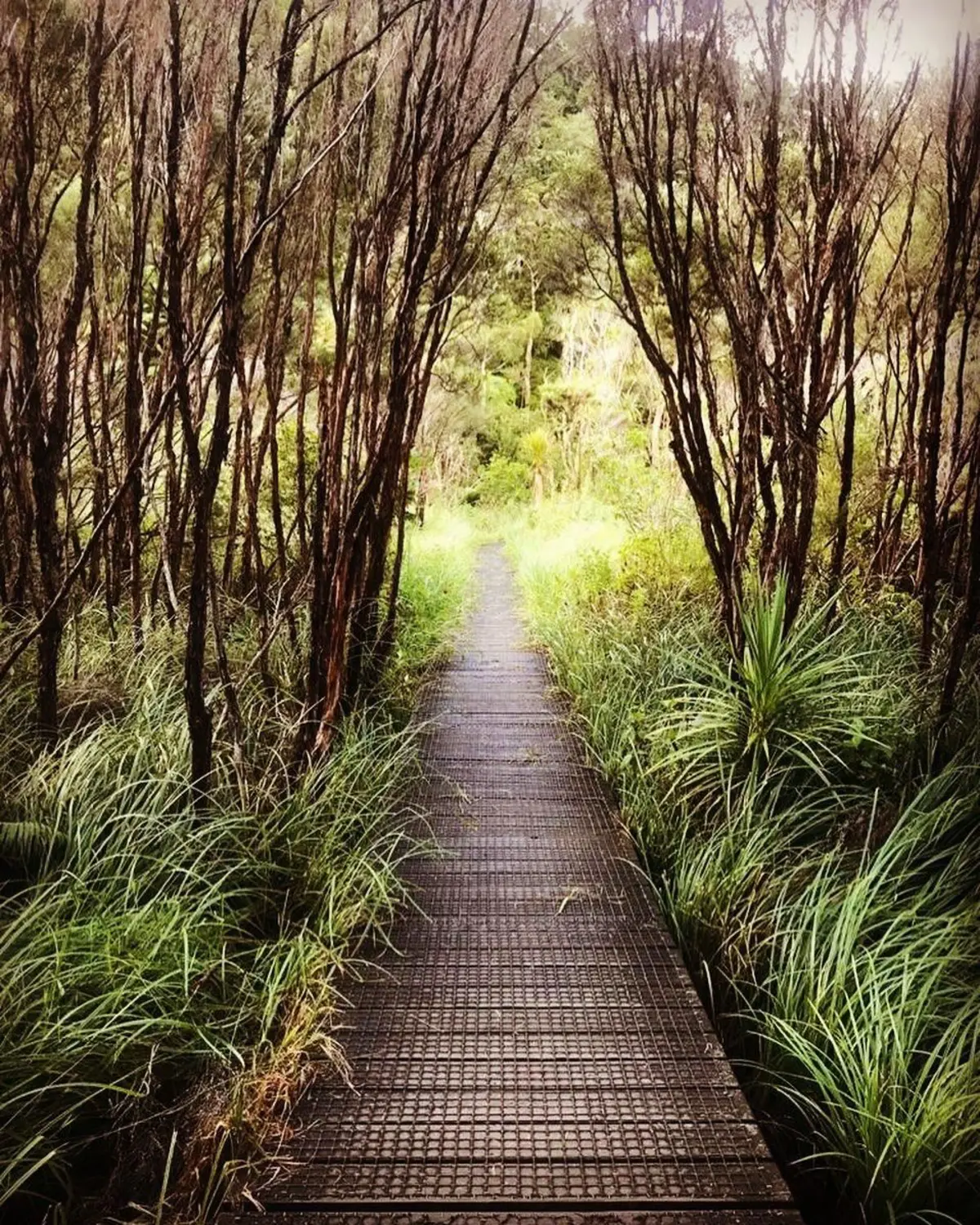
The track is graded Easy by DOC. It’s approximately 3km return — about 45 minutes each way — and the terrain earns that easy rating. It starts flat, stays flat, and doesn’t surprise you with any sudden climbs.
The first section crosses the Kaitoke Wetlands on a raised boardwalk. Underfoot is waterlogged ground; overhead is kānuka. If you’re moving quietly and looking at the track edges, there’s more going on than you’d expect. Native orchids flower close to the path. Sundews — the insect-eating plants — grow in the boggy margins. Fernbirds (mātātā) call from the reeds: a metallic double-click, easy to miss if you’re not listening for it. The spotless crake is here too, though you’ll hear it before you see it, if you hear it at all.
The initial boardwalk section is pushchair-friendly — worth knowing if you’re bringing young children.
The Upper Bush
After the wetland crossing, the character of the walk shifts. The forest thickens and closes in. The track enters a section of genuinely old bush — rimu, Kirk’s pine, pink pine, kauri — that survived the 19th and early 20th-century logging because the terrain was too steep for the timber companies to reach. Most of Great Barrier’s lowland forest was cleared between the 1880s and 1930s. This section wasn’t. That’s not a small thing. Old-growth conifer forest is rare in the Auckland region, and what survives here does so because it was inconvenient to destroy.
The sulphur smell arrives in this upper section, well before the pools come into view. It’s not overpowering — just enough to announce what’s coming.
The Pools
The Kaitoke Hot Springs aren’t a purpose-built facility. They’re a thermal stream meeting a cold creek at a natural fork in Kaitoke Creek, dammed at the junction into a main pool. The pool is ringed with umbrella fern. There’s a picnic table and a public toilet nearby. That’s the infrastructure. That’s all of it.
Temperature is positional. Where you sit determines how warm you get. The thermal water is hotter towards the source; the cold creek brings the temperature down depending on the mix at any given point. The main pool runs warm to tepid most of the year — comfortable for a long soak, genuinely pleasant, but not going to cook you.
If you want hotter: five minutes further upstream there are upper pools that are noticeably warmer, more enclosed, and almost always quieter. Most visitors stop at the main pool; the ones who keep going are rewarded.
DOC safety note: The water near the thermal source can be scalding. DOC advises against submerging your head in the pools. Take this seriously — the variation in temperature isn’t always obvious until you’re in the wrong spot.
When to Go
Winter is the standout season. This is not the usual travel-guide hedge of “every season has its charms.” In winter, the contrast between cold air and warm water is what makes Kaitoke genuinely memorable. Steam rises from the pools into the cold bush air. You’re likely to have the pools mostly to yourself. The experience shifts from “tourist attraction” to something that feels more like a local discovery — even though it isn’t actually a secret.
For more on what Great Barrier looks like in the quieter months, the winter on Great Barrier Island guide covers it well.
Summer is perfectly good — the walk is pleasant, the pools are warm, the birds are active — but summer afternoons can get busy, especially when day-trippers from the ferry arrive. The main pool is not large; 15 people in it starts to feel crowded. If you’re visiting in December through February, go early morning or late afternoon.
Early morning, any season, is almost always the right call. You’ll likely have the pools to yourselves, or near enough. The forest in morning light is worth it regardless.
What to Bring
Swimwear — there are no changing rooms at the pools, so the easiest approach is to wear your togs under your clothes.
A towel — obvious, but don’t forget it.
Footwear — the track is easy and the boardwalk keeps your feet dry over the wetland section, but the upper track can be muddy after rain. Trail shoes or light hikers are ideal. Jandals work on a dry day but won’t cut it when it’s wet. Don’t attempt this in heels.
Water — the track is short but bring some anyway, particularly in summer.
Insect repellent — the wetland edge has sandflies in the warmer months. Worth having.
Kauri dieback awareness — there are footwear cleaning stations at the trailhead. Use them before you enter the bush and when you leave. The mature kauri in the upper track section is exactly what kauri dieback threatens; cleaning your shoes is the one thing visitors can actually do to help.
What not to bring: expectations of infrastructure. There are no showers, no changing rooms, no café, no lockers. The pools are found, not managed. That’s the whole point.
The Rest of the Day
Kaitoke Beach is a short drive from the trailhead — a long northeast-facing surf beach with consistent waves and almost nobody on it. If you’ve got a board or just want to watch the water for a while, it pairs well with a morning at the springs.
Windy Canyon is on the same road back towards Claris — 20 minutes of steep volcanic walls and a century-old timber winch frame that stops you mid-stride. It’s the best short walk on the island and takes about an hour. Do it on the way back.
And if you’re staying at 175° East — Pītokuku House, Ruru House, or Tree House — you’re 20 minutes away, which means you can be back at Medlands Beach by lunch. That’s a pretty good morning.
For more ideas, the complete guide to things to do on Great Barrier Island covers the full range — including what’s nearby at the Mason Rd Hub (Aotea Brewing and Aotea Roast are five minutes from the 175° East properties).
Common Questions
Is there a fee to visit Kaitoke Hot Springs?
No. The Kaitoke Hot Springs are DOC-managed and completely free to visit. There’s no entry fee, no parking charge, and no booking system. You turn up, you walk in, you get in the water.
How far is Kaitoke Hot Springs from Medlands Beach?
About 20 minutes by car. The trailhead is on Whangaparapara Road — easy to find, good parking. Once you’re there, it’s a 45-minute walk one way on a flat, easy track through native bush. Allow 3–4 hours for the full outing including time at the pools.
Can you take kids to Kaitoke Hot Springs?
Yes — the track is graded Easy and the early boardwalk section over the wetlands is pushchair-friendly. Young children handle the full walk comfortably. The one thing to watch carefully: the pool water can be very hot near the thermal source. Supervise children closely at the pools, and keep them away from the upper reaches of the stream where temperatures are highest.
Is winter actually better than summer?
For Kaitoke Hot Springs specifically, yes — and it’s not a close call. The thermal steam rising into cold winter air is the version of this experience that people remember. Summer visits are perfectly good, but the pools can get busy on summer afternoons and the atmospheric contrast just isn’t there in the same way. If you have the choice, go in winter. It’s also when the island is quietest — you’re very likely to have the pools to yourself.
Are the pools hot enough to actually feel like hot springs?
The main pool is warm to tepid year-round — a comfortable soak, not a scalding challenge. The upper pools, five minutes further along the stream, are noticeably hotter. If you’ve come expecting Rotorua-style thermal drama, Kaitoke will feel quieter than that. If you’ve come for warm water in old-growth bush with nobody else around, it delivers exactly that.
Do you need to book?
No booking required. The springs are open year-round and there’s no reservation system. Just show up, clean your footwear at the trailhead station, and walk in.
Practical Info
| Trailhead | Whangaparapara Road, Great Barrier Island |
| Distance | ~3km return |
| Grade | Easy (DOC) |
| Time | 45 min one way |
| Cost | Free |
| Facilities | Toilet and picnic table at trailhead; toilet and picnic table at main pool |
| Nearest accommodation | 175° East, Medlands Beach — 20 min drive |
175° East has three off-grid houses at Medlands Beach — 20 minutes from the Kaitoke trailhead. Check availability and book direct.