
The first thing to know about choosing where to stay on Great Barrier Island is that the island is bigger than it looks.
Not in kilometres. In driving time.
A road that seems short on Google Maps can wind through hills, drop to a harbour, turn to gravel and quietly eat half an hour. You will not mind the view, but you may mind doing it twice a day because your accommodation is at the opposite end of the island from everything you planned.
There is no main town and no hotel strip. Great Barrier Island accommodation is scattered around beaches, bush and small settlements. Medlands feels nothing like Port Fitzroy. Tryphena and Whangaparapara could almost be on different islands.
So here is the useful version, without pretending every area is perfect for everyone.
The Blunt Answer: Medlands Is the Best Base for Most People
For a first trip, Medlands Beach is the easy pick.
You are near Claris for the airport, groceries and fuel. Tryphena is close enough for dinner or a ferry connection. The roads north, south and west are all within reach. Most importantly, you are beside a 1.5-kilometre white-sand beach rather than staying somewhere practical and driving to one.
That last bit matters. A day on Aotea often starts slowly. Coffee takes longer. Someone wanders onto the deck. The beach looks good. Suddenly it is eleven. At Medlands, that is fine. You can walk down for a swim or surf and decide what the day is doing afterwards.
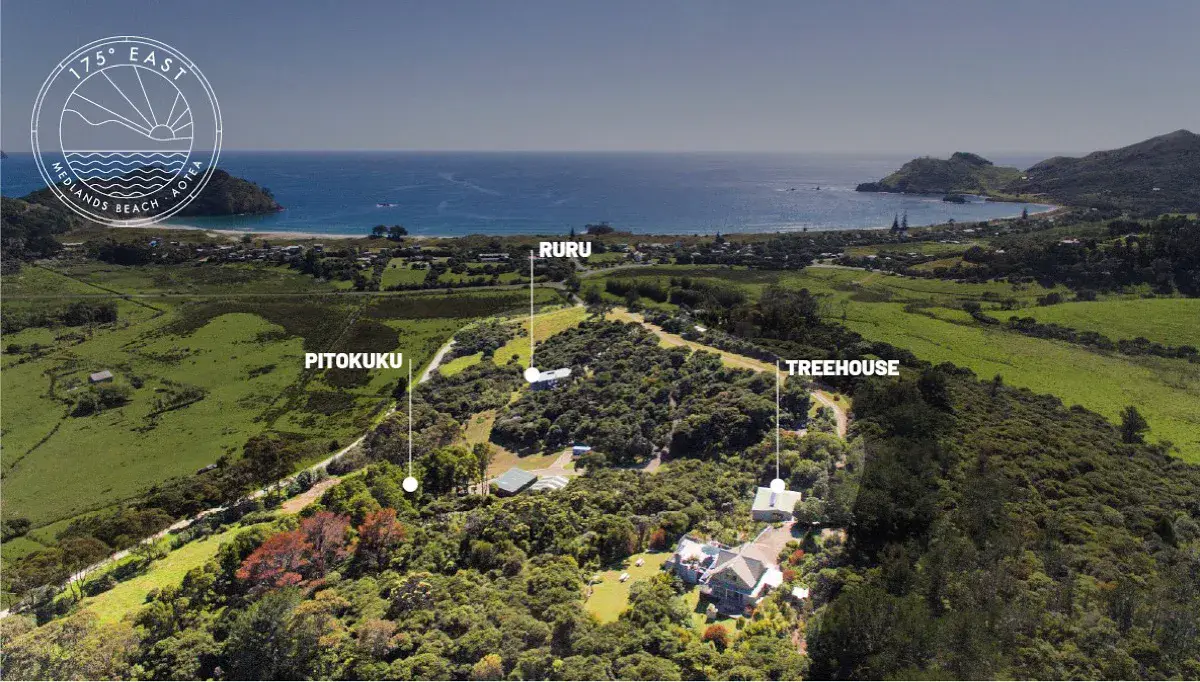
From 175° East, Medlands Beach is an 8-minute walk. Aotea Brewing and Aotea Roast are about five minutes away in the other direction. Claris is nearby when you need supplies; native bush and the open coast make it feel much further away.

Medlands is exposed to the east, so you hear the surf and get the weather when it comes through. If you want glassy harbour water and a boat on a mooring, look north or west. If you want a beach holiday with a good position for exploring the rest of Aotea, stay here.
What the Other Parts of Great Barrier Island Are Like
Tryphena
Tryphena makes sense if you are coming on the SeaLink ferry and want shops, food and sheltered bays close by. It is the most settled part of the island, although “settled” is relative. There are still no traffic lights and nobody is rushing to build one.
The harbour beaches are calmer than Medlands, which suits young children and anyone who would rather paddle than surf. You have a few places to eat and it is easier to grab something you forgot.
For a short southern stay, Tryphena is handy. For exploring the whole island, it is less central than Medlands. Port Fitzroy and the northern tracks are a decent haul, and you may spend more of the holiday in the car than expected.
Claris and Kaitoke
Claris is the practical centre of Aotea. The main airport is there, along with shops, fuel and services. Kaitoke is just north, close to the hot springs, wetlands and east-coast beach.
If you are flying in for two nights, coming mainly to walk, or simply want everything straightforward, the area works well. Land, collect the car, buy groceries, done.
It is useful rather than especially atmospheric. You may be perfectly happy with that. A good holiday does not need every window to look like a postcard.
Port Fitzroy and the North
The north is for people who already know why they are going there.
Port Fitzroy has sheltered harbour water, boats, fishing and deep green hills. Glenfern Sanctuary and the northern walking tracks are close. It is quiet even by Aotea standards, and evenings beside the harbour are hard to beat.
The trade-off is distance. If you stay in the north, stay in the north. Driving to Medlands for a surf, Tryphena for dinner and back again is possible, but it is not a clever daily routine. Shop hours matter more up there too, so arrive with food and a plan.
For boaties, fishers, walkers and repeat visitors who want to disappear for a while, Port Fitzroy is excellent. For a first visit with a long list of things to see, it can feel a bit tucked away.
Whangaparapara and the West Coast
Whangaparapara is the moodier side of the island. Sheltered harbour, steep bush, old mining and timber history, and very little going on in the best possible way.
It suits trampers, fishers and anyone staying near the Aotea Track. It also suits people who bring what they need and do not expect to wander out for dinner on a whim.
The west coast is beautiful, but it is not a convenient base for an east-coast beach holiday. Stay there because you want Whangaparapara itself, not because the map made it look central.
Pick the House for the People You Are Bringing
Families need a full kitchen, somewhere to dry wet towels and enough room for a rainy afternoon. Couples generally need less house and more privacy. Groups need to be honest about numbers before somebody ends up on a sofa they were told was “basically a bed”.
At Medlands, Pītokuku House is the big one. It sleeps 10, has a separate cabin and bunk room, and an outdoor fire on the back deck. It is a good setup for two families or a group that wants to spend most of its time together.
Ruru House sleeps 7 and feels more private. It sits higher on the hillside with north-facing decks, views over the valley and an outdoor bar window that tends to become the centre of the evening. It suits a couple, a family or a smaller group.
Tree House sleeps 8 among the mānuka and kānuka canopy. Kids go straight for the bunk room and hammocks. Adults usually find the deep red clawfoot bath first. It is the oddest of the three houses, which is meant as a compliment.
If one already sounds right, check availability for your dates. If you need more than one house, compare the multi-house options for groups of up to 25.
For couples weighing up the island, the romantic Great Barrier Island guide goes into more detail.
If the trip is mostly about walking, work backwards from the tracks. Port Fitzroy and Whangaparapara are better for the northern and western routes. Medlands or Claris are easier if you want a mix of walks, beaches, hot springs and food. The complete things-to-do guide will help before you commit to an area.
A Few Things Worth Checking Before You Book
First, get the exact location. “Great Barrier Island” is not precise enough. Ask how far the house is from the airport or ferry, the nearest shop and the places you actually want to visit.
Then ask about the road. Some accommodation is reached by steep or rough access that may not suit every rental car. This is much better discovered before arrival than halfway up a driveway.
The whole island is off-grid, but houses handle that differently. Check the solar setup, heating, hot water and internet. If you need to work, do not accept “WiFi available” as the full answer. Ask whether it is Starlink and whether video calls are reliable. Mobile coverage varies from decent to nonexistent depending on where you stand.
Also check the kitchen. Aotea has good local food, but opening days and hours move with the season. Self-catering is normal, and the shops are not Auckland supermarkets with smaller signs. Bring anything specific from the mainland.
Rainwater is the other island reality. You do not need to live like a desert hermit, but twenty-minute showers are frowned upon for good reason.
Finally, read the cancellation terms. Flights and ferries are weather-dependent. Most trips run as planned; occasionally Aotea reminds everyone who is in charge.
All three houses at 175° East have solar power, rainwater collection, Starlink WiFi, full kitchens, Nespresso machines, hot showers and wood burners. They are off-grid, not bare-bones.
Why Medlands Keeps Winning the Argument
Plenty of places on Aotea are more remote. A few are closer to a shop. Port Fitzroy has calmer water. Tryphena has the ferry. Claris has the airport.
Medlands has the balance.
Before breakfast, you can walk down to one of the island’s best beaches. During the day, head to Kaitoke Hot Springs, Windy Canyon, Tryphena or the west coast. In the evening, walk to Aotea Brewing or stay put. After dark, step outside into Aotea’s Dark Sky Sanctuary.
There is enough nearby that the holiday is easy, but not so much that it stops feeling like Great Barrier Island.
175° East sits on 14 acres of bush and farmland above the beach. Pītokuku sleeps 10, Ruru sleeps 7 and Tree House sleeps 8. Pick the house that fits, or take more than one if the group is getting ambitious.
Wherever you stay, hire a car, buy your groceries early and leave gaps in the plan. Aotea has never been especially interested in tight schedules.
For the practical bits, read the guide to getting to Great Barrier Island.